How to Choose the Right Piezoceramic Actuator for Your Application?
Choosing the right Piezoceramic Actuator is crucial for your specific application. These devices convert electrical energy into mechanical motion. They are widely used in various industries, from robotics to medical devices. However, selecting the right one can be challenging.
Consider the actuator's specifications, such as size or shape. These factors can impact performance. Different applications require different levels of precision. Not all Piezoceramic Actuators are created equal. Some may not meet the unique demands of your project.
Think about the operational environment. Will it be exposed to extreme temperatures? Also, consider the material it interacts with. It should be compatible to avoid issues. These reflections can guide you toward a suitable choice. Exploring options may reveal surprising limitations in some products. As you delve deeper, keep questioning if you truly understand your needs.
Understanding Piezoceramic Actuators and Their Applications
Piezoceramic actuators play a crucial role in various applications, from robotics to medical devices. These devices convert electrical energy into mechanical motion, enabling precise movements. Understanding their structure and functions helps in selecting the right type for your needs.
In diverse applications, these actuators can be found in ultrasound equipment, where they generate sound waves. They are also used in precision positioning systems. The efficiency of these actuators makes them ideal for such tasks. However, their selection depends on specific parameters, like frequency response and displacement.
Consider the operating environment as well. Temperature and humidity can affect performance. Some users overlook these factors, which can lead to unexpected failures. Each application's unique requirements must influence the choice of actuator. It’s essential to reflect on the intended use to make informed decisions.
Key Parameters to Consider When Selecting Piezoceramic Actuators
When selecting piezoceramic actuators, several key parameters must be considered. First, the actuator's displacement range is crucial. A larger range often allows for more versatile applications. For example, a report by the International Society for Optical Engineering suggests that actuators with a displacement of 100 µm are common in precise applications like optical positioning.
Another critical parameter is the working frequency. Many applications require actuators that can function within specific frequency ranges. Frequencies can range from a few Hertz to several kHz, depending on the application. Focusing on a proper frequency match can enhance performance. As an industry report from Applied Physics Letters points out, mismatched frequency can lead to suboptimal actuator performance.
Thermal stability is also significant. Some materials may suffer from non-linear responses due to temperature fluctuations. This factor often complicates the selection process. A study published in the Journal of Micromechanics and Microengineering found that temperature changes could lead to a variation of 10% in performance. Therefore, businesses must weigh options carefully, considering both environmental factors and actuator specifications. It is a balancing act between performance and limitations.
Comparison of Key Parameters for Piezoceramic Actuators
This bar chart illustrates the comparison of key parameters of piezoceramic actuators, including Force, Displacement, Response Time, Voltage, and Weight. Each parameter is essential when selecting the appropriate actuator for specific applications.
Comparative Analysis of Different Types of Piezoceramic Materials
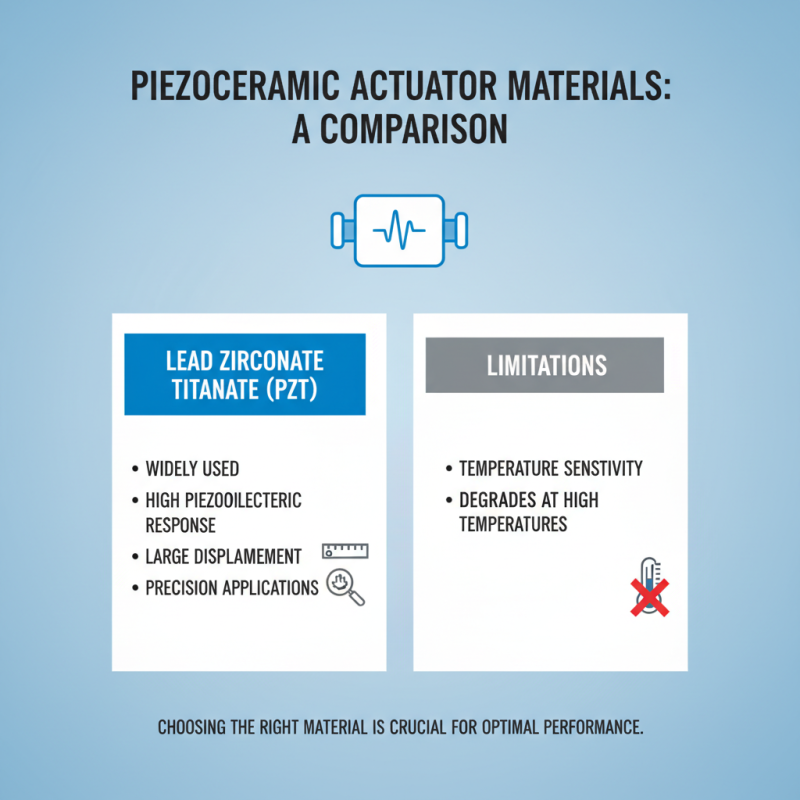
When selecting a piezoceramic actuator, understanding the materials is crucial. Piezoceramic materials differ significantly in their characteristics. For instance, lead zirconate titanate (PZT) is widely used due to its high piezoelectric response. It can produce large displacements, making it ideal for applications requiring precision. However, PZT has limitations, such as temperature sensitivity. Exposure to high temperatures can degrade performance.
Conversely, barium titanate (BaTiO3) serves as a lead-free alternative. It has lower piezoelectric coefficients compared to PZT, yet it remains stable at higher temperatures. This characteristic is valuable for industries where thermal reliability is essential. A recent industry report indicated that BaTiO3 has become increasingly popular, particularly in environmentally conscious applications.
Both types have trade-offs. PZT offers superior performance in force generation, yet it raises environmental concerns. BaTiO3 presents a safer profile but may not meet high-performance requirements. Each application's specifics should guide the selection process. Evaluating compatibility and performance under expected conditions is key. There’s no one-size-fits-all solution; understanding these nuances informs better choices.
Evaluating Performance Metrics for Your Specific Use Case
When selecting a piezoceramic actuator, understanding performance metrics is crucial. First, evaluate the actuator's displacement and force output for your application. Reports indicate that piezoceramic actuators can provide displacement ranges from 0.05 mm to over 2 mm. The specific requirements might lead you to choose an actuator with either lower or higher displacement.
Frequency response is another key metric. A study found that many high-performance actuators can operate effectively between 5 kHz to 150 kHz. However, exceeding this range could lead to inefficient energy use or potential damage. It's critical to match the operational frequency with your application needs.
Consider environmental factors too. Temperature and humidity can significantly affect performance. While many actuators perform well in standard conditions, some may not. Selecting actuators for extreme conditions requires careful research. Bearing in mind these factors will help in choosing the right actuator tailored to individual specifications.
How to Choose the Right Piezoceramic Actuator for Your Application? - Evaluating Performance Metrics for Your Specific Use Case
| Parameter |
Value |
Unit |
| Maximum Displacement |
100 |
µm |
| Blocking Force |
200 |
N |
| Resonant Frequency |
50 |
kHz |
| Voltage Rating |
150 |
V |
| Power Consumption |
3 |
W |
| Temperature Range |
-20 to 80 |
°C |
Integration and Installation Considerations for Piezoceramic Actuators
When selecting piezoceramic actuators, integration and installation are critical factors. These devices convert electrical signals into mechanical movement. Their compact size allows for integration into various systems. Installation must consider spacing, mounting surfaces, and alignment. Misalignment can lead to performance issues. In fact, improper installation can reduce efficiency by up to 20%, according to a recent industry report.
The electrical connections are another key aspect. Ensure they are robust and can handle the required voltage. Weak connections can result in intermittent failures, impacting overall system reliability. Environment plays a role too. High temperatures and humidity can affect performance. Some reports indicate that actuation efficiency drops by 15% in less than ideal conditions.
Finally, it’s essential to understand the application requirements. Systems may vary in dynamic response and frequency range. Failure to choose actuators that match these needs can lead to poor performance. Reflection on your specific requirements is necessary. It’s not just about selecting a product; it’s about ensuring it fits well with your overall design.