2026 How to Choose the Right Piezo Fan for Your Needs?
Choosing the right Piezo Fan is crucial for your projects. These fans offer unique advantages, such as compact size and efficient cooling. However, not all Piezo Fans are created equal. Selecting the most suitable one can be challenging.
Consider your specific needs. Size, airflow, and noise level are important factors. Some fans may look appealing but fail to deliver adequate performance. It's essential to match the fan's specifications with your requirements. Research can aid in making an informed decision, yet personal experience is equally valuable.
Be aware that technology is constantly evolving. A fan that works today might not be the best choice in a few years. Embrace the learning process. Understand that your initial choice may not always be perfect. This journey can help refine your understanding of Piezo Fans and their applications.
Understanding the Basics of Piezo Fans and Their Applications
When selecting a piezo fan, it's crucial to understand their basic operation and myriad applications. Piezo fans utilize the unique properties of piezoelectric materials. These materials expand and contract when an electric current is applied. This movement generates airflow without the need for traditional motor mechanisms. Industry surveys reveal that piezo fans can achieve airflow rates up to 4.7 CFM while maintaining ultra-low noise levels, making them ideal for sensitive environments.
Applications for piezo fans span various sectors. In medical devices, for example, precise airflow is vital for cooling components in imaging equipment. In telecommunications, piezo fans help regulate temperatures in circuit boards. Research indicates that nearly 25% of electronic devices utilize piezoelectric technology for cooling purposes. However, one should note that while piezo fans are efficient, they may not be suitable for high-volume cooling needs. Their design limits effective air movement in larger spaces, prompting reflection on specific operational requirements.
Environmental impact is another aspect to consider. Although piezo fans are energy-efficient, their lifecycle analysis suggests potential waste issues. Some piezoelectric materials can contribute to electronic waste. A holistic view of their performance and environmental footprint is essential for choosing the right fan. Understanding both benefits and limitations can lead to more informed decisions.
Factors to Consider When Selecting a Piezo Fan
When selecting a piezo fan, several key factors come into play. The size of the fan is critical. A well-fitted fan ensures efficient airflow in your application. According to a recent industry report, improper sizing can decrease performance by up to 30%. Take dimensions seriously. Additionally, the power consumption of the fan cannot be overlooked. Many piezo fans are energy-efficient, yet some models consume excessive power. Always check the specifications.
Noise levels are also essential. Piezo fans are known for their quiet operation, but not all models are the same. A study indicates that some fans operate above 40 decibels, which may not suit sensitive environments. Testing noise output before purchase is advisable. Moreover, consider the intended application. Some fans are better for cooling electronics, while others excel in low-profile designs.
Lastly, durability and material quality matter. Fans made from robust materials can last longer, reducing replacement costs. However, cheaper alternatives may fail prematurely. Reviews often highlight the trade-offs between cost and longevity. Users should evaluate their priorities carefully. Each factor demands thoughtful consideration to ensure the right choice for your needs.
Comparing Different Types of Piezo Fans for Efficiency
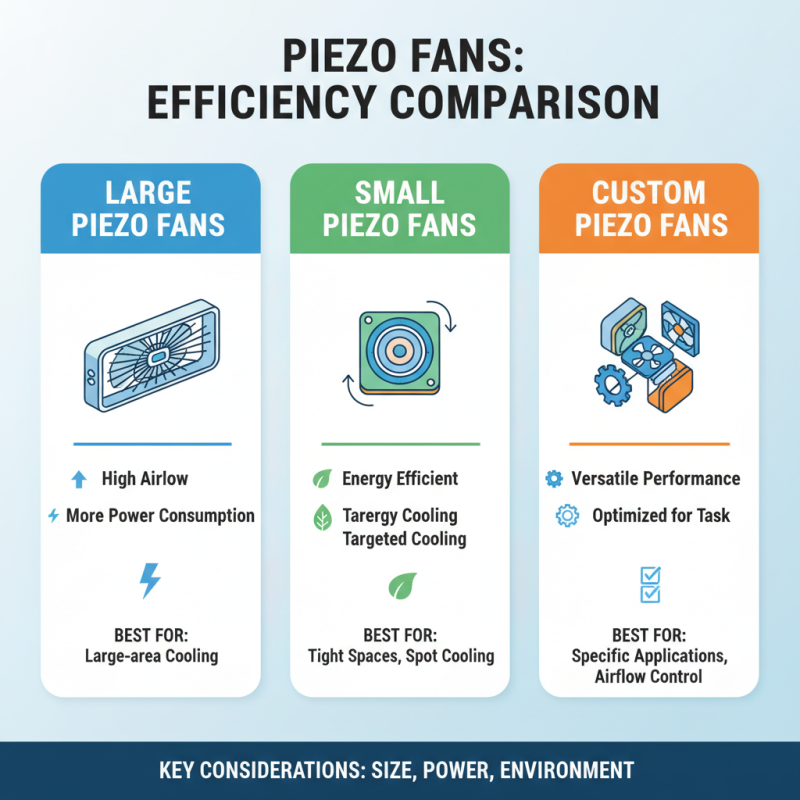
When selecting a piezo fan, efficiency matters. Different types can serve distinct purposes. Always evaluate how they function in various environments. Some fans excel in cooling, while others might be better for airflow. Pay attention to their size and power. Larger fans often produce more airflow but can consume more energy. Smaller fans can be efficient in limited spaces but may underperform in larger areas.
Types of piezo fans include axial and centrifugal designs. Axial fans push air in a straight line. They are commonly used for cooling computer components. Centrifugal fans, on the other hand, draw air in and expel it at an angle. They can be more effective in applications requiring high pressure. Consider your specific needs. Do you need more pressure or more airflow? Each type has its benefits.
Lastly, don’t ignore noise levels. Some fans operate quietly, while others can be loud. Think about where you will place the fan. A noisy fan in a quiet room can be a significant concern. Ultimately, weigh all these factors carefully. Choosing the right piezo fan may require some trial and error. Reflect on past choices. What worked well? What didn’t? This can guide your decision-making process.
Determining the Required Specifications for Your Application
Choosing the right piezo fan starts with understanding your specific requirements. Applications can vary widely, from electronics cooling to medical devices. Different environments may dictate distinct specifications. For instance, a fan used in a compact electronic enclosure might require a low profile design. In contrast, fans for larger applications may prioritize airflow over size.
The required specifications include airflow, noise level, and voltage. Airflow is crucial. Reports indicate that optimal airflow increases efficiency by up to 30%. Noise levels should be kept minimal, typically below 30 dBA for sensitive applications. Voltage specifications also matter, as most piezo fans operate efficiently within a narrow voltage range.
When assessing your application, consider power consumption. Data reveals that energy-efficient fans can reduce operational costs by 20% annually. It's vital to analyze if your chosen fan can maintain performance under varying conditions. Many users overlook this, which can lead to underwhelming results. Testing the fan in real-world conditions is necessary. Relying solely on manufacturer data may not reveal all nuances. Therefore, it’s important to evaluate and adjust based on actual performance.
2026 How to Choose the Right Piezo Fan for Your Needs?
This chart displays the comparison of various specifications for piezo fans suitable for different applications. The parameters considered include airflow (CFM), noise level (dBA), and power consumption (W).
Evaluating Cost-Effectiveness and Reliability of Piezo Fans
When choosing a piezo fan, cost-effectiveness and reliability are key factors. You want a fan that provides good airflow without breaking the bank. Analyzing the upfront cost is essential. However, consider the long-term expenses. A cheaper fan may have higher energy consumption. This can lead to increased electricity bills over time. In contrast, a slightly pricier fan might save money in the long run.
Reliability is equally important. A fan that frequently malfunctions can lead to equipment overheating. This can cause damage and incur additional repair costs. Check reviews and available data. Not all piezo fans perform equally under pressure. Look for fans specifically designed for your particular application. The environment also matters; some fans are better suited for high temperatures or dust-prone areas.
Don’t forget to weigh the trade-offs. Sometimes, a low-cost option seems appealing but may lack durability. A more expensive fan might offer greater longevity. It’s a balancing act. Always reflect on your specific needs while considering these factors. Making an informed decision can ultimately save you time and money.