Top 10 Innovations in Piezo Technology for Everyday Applications?
Piezo Technology has seen remarkable advancements, impacting our daily lives in diverse ways. These innovations enhance our interaction with technology, driving efficiency and sustainability. According to a recent report by Market Research Future, the global piezoelectric devices market is projected to reach $27 billion by 2025. This growth signifies the increasing importance of Piezo Technology in modern applications.
Dr. Emily Chen, a leading expert in the field, states, “The potential of Piezo Technology is vast, with applications emerging daily.” This highlights the broad scope of this technology, which includes sensors, actuators, and energy harvesters. Recently, we have witnessed piezoelectric sensors in smartphones and smart home devices. However, while these innovations are impressive, challenges remain. The integration of piezoelectric materials into existing technologies often requires careful engineering.
Despite the strides made, there is a need for continual research. The market demands efficient solutions, pointing towards a future where Piezo Technology is indispensable. Addressing its limitations will be key to unlocking its full potential. As the industry evolves, staying ahead in this dynamic landscape will require collaboration and innovation.

Advancements in Piezo Technology: An Overview of Innovations
Recent advancements in piezo technology have transformed numerous everyday applications. These developments focus on efficiency, responsiveness, and adaptability. According to a report from the International Journal of Engineering Research, the global piezoelectric device market is expected to grow by 5.9% annually, driven by innovations in various sectors.
One notable innovation is in smart sensors. Piezoelectric sensors can detect pressure changes, enabling applications in automotive and personal health devices. These sensors provide real-time data, enhancing safety measures and health monitoring. Additionally, advancements in energy harvesting techniques allow piezo devices to convert mechanical stress into usable electrical energy. Reports indicate that such systems could power small devices, reducing dependency on conventional batteries.
Despite these advancements, challenges remain. The integration of piezo technology into complex systems often reveals compatibility issues. Certain environments may limit the sensor's effectiveness. Such factors necessitate ongoing research and development to enhance performance. Understanding these challenges can guide future innovations, ensuring that piezo technology continues to evolve and meet user needs effectively.
Medical Applications of Piezo Technology: Enhancements in Patient Care
Piezo technology is changing medical care. It uses pressure and vibrations to create energy. This innovation offers new tools for doctors and patients alike. Devices like ultrasound machines now benefit from piezoelectric sensors. These sensors improve imaging quality, making it easier to detect conditions early. Enhanced diagnostics lead to better treatment plans.
Tips: Consider how wearables could improve patient monitoring. Smaller piezo sensors allow for real-time tracking of health metrics. Patients and doctors stay informed about vital signs without invasive procedures.
Piezo technology also aids in pain management. Devices using piezoelectric materials can stimulate nerves. This stimulation may lead to reduced pain and faster recovery times. Yet, while effective, some patients find adjusting to these therapies challenging. There’s still much to learn.
Tips: Communication is key for patient acceptance. Discuss the benefits and potential discomforts openly. Understanding leads to better patient cooperation in their care journey.
Piezo Sensors in Consumer Electronics: Revolutionizing User Interfaces
In recent years, piezo technology has transformed how we interact with consumer electronics. Piezo sensors are at the forefront of this revolution. They enable touch-sensitive surfaces, making devices more intuitive. Users can now control functions with simple gestures. The responsiveness of these sensors enhances user experiences significantly.
Tips: Consider the sensitivity of piezo sensors. Too much responsiveness can lead to accidental activations. Users might find these frustrating, especially when using devices in quick succession.
Piezo sensors minimize the need for physical buttons. This innovation reduces wear and tear on devices. It also allows for sleeker, more aesthetically pleasing designs. However, not all users adapt well to entirely touch-based interfaces. Some individuals prefer tactile feedback for accuracy.
Tips: Encourage users to adjust sensitivity settings in their devices. This can help bridge the gap between touch and traditional methods. Gradual exposure to touchscreen interfaces can also ease this transition.
Top 10 Innovations in Piezo Technology for Everyday Applications
| Innovation |
Application |
Description |
Impact |
| Touch Sensitivity |
Smartphones |
Enhanced touch sensing capabilities that improve user interaction. |
Increased user engagement and accessibility. |
| Gesture Recognition |
Home Automation |
Control devices through hand gestures, reducing the need for physical buttons. |
Enhanced convenience and modern aesthetics. |
| Pressure Sensing |
Wearable Devices |
Monitors pressure applied to skin for fitness tracking. |
Improved health monitoring tools for consumers. |
| Vibration Feedback |
Gaming Controllers |
Provides tactile feedback to enhance gaming experiences. |
More immersive gameplay and user satisfaction. |
| Sound Wave Control |
Home Audio Systems |
Uses piezo technology to control and enhance sound production. |
Improved audio clarity and user experience. |
| Miniature Sensors |
Smart Appliances |
Compact sensors that monitor various appliance functions. |
Enhanced functionality and efficiency of home devices. |
| Energy Harvesting |
Wearable Tech |
Harvests energy from body movements to power devices. |
Increased autonomy and reduced battery reliance. |
| Smart Textiles |
Fashion Tech |
Integrates sensors into fabrics for various smart applications. |
Enhanced functionality and personal expression in clothing. |
| Customizable Interfaces |
Office Devices |
Allows users to modify device interactions based on personal preferences. |
Increased personalization and user satisfaction. |
| Health Monitoring |
Medical Devices |
Uses piezo sensors to monitor vital signs continuously. |
Improved patient outcomes through real-time monitoring. |
Energy Harvesting with Piezo Devices: Sustainable Power Solutions
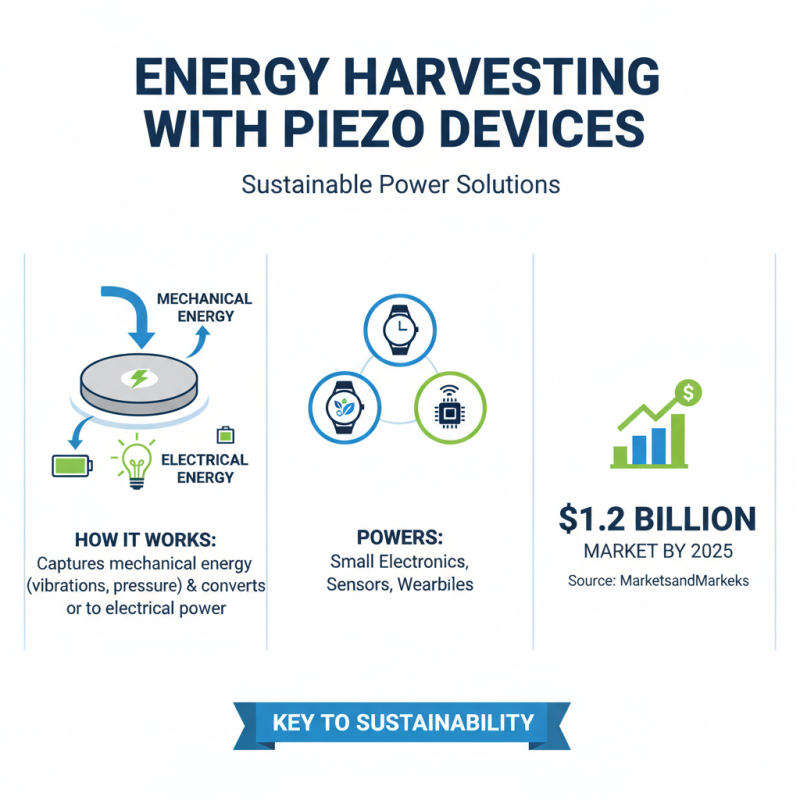
Energy harvesting through piezo devices is gaining attention in sustainability. These devices capture mechanical energy and convert it into electrical energy. This process can power small electronics, sensors, and wearables. A report by MarketsandMarkets estimates that the piezoelectric energy harvesting market will reach $1.2 billion by 2025, reflecting its growing importance.
One exciting application is in smart buildings. Piezo materials can be used in flooring or infrastructure to generate energy from human movement. A study found that footfalls can generate up to 10 watts of power per square meter. This electricity can help run lighting systems and smart devices. However, challenges remain. Energy output can be inconsistent and may not always meet demands.
Another area is wearable technology. Piezoelectric materials can power devices through body movement. Research indicates that these systems can generate enough energy for low-power devices by simply walking. Yet, the efficiency of such systems is still a concern. More development is needed to optimize energy capture and ensure reliability. As this technology matures, the potential for sustainable energy solutions continues to grow.
Smart Materials: The Role of Piezo Technology in Modern Engineering
Piezo technology plays a vital role in modern engineering. This innovative field uses smart materials that change shape or size when subjected to electrical stress. Such changes allow for a wide range of applications. From sensors to actuators, piezo technology is reshaping how we interact with devices. Imagine a wall that can sense vibrations and adjust its properties to enhance sound insulation. This is not science fiction; it is the potential of piezo materials.
One intriguing use is in energy harvesting. Devices can capture energy from everyday activities, like walking. These energy harvesters convert mechanical energy into electrical energy, powering small electronics. However, challenges exist. The efficiency of these piezoelectric elements often needs improvement. Additionally, optimizing their integration into existing systems can be complex. Engineers must balance performance with size and adaptability.
Another fascinating application is in the healthcare sector. Piezo technology can improve diagnostic tools, such as ultrasound devices. The precision of these tools enhances patient care significantly. Yet, as quality rises, manufacturers face the pressure to keep costs low. This balance between innovation and affordability is crucial for widespread adoption. Investing in research will be essential for overcoming these hurdles.
Top 10 Innovations in Piezo Technology for Everyday Applications