


Revolutionary Applications of Tactile Feedback Technology in AR/VR Wearables
1.Introduction
2.Design Next-Generation Technology
3.Mainstream Forms Factors for Wearables
4.Application Cases
5.The Path towards Full Immersion
6.Conclusion
Introduction
The ground on which computing operates is being thoroughly revised. For decades, the human-computer interaction was limited to flat screens and sound. Today, we're seeing a move away from interfaces that are limited to screens and towards full-body spatial computing that engages several human senses at a time.
At the core of this change is haptic feedback technology; the study of providing tactile feedback through physical interaction. In simple terms, the haptic feedback definition refers to the usage of controlled forces, vibrations or movements, which re-create the sense of touch in digital environments.
While visual and audio components of immersive systems have achieved impressive levels of sophistication, the absence of physical sensation has been the missing link to that point. Haptic feedback fills in this gap and renders "virtual presence" into closer-to-physical reality experiences.
By 2026, the XR space has made a serious strategic move towards the design of haptics first. Leading technology companies have now realised that immersive experiences cannot be based on sight and sound. Touch, as our most basic sensory channel which has become key to believable digital environments. This is not an incredible incremental upgrade. It is a fundamental rethink of the way humans interact with digital content that unlocks applications that have been off limits.
Design Next-Generation Technology
Traditional haptic feedback systems made extensive use of eccentric rotating mass (ERM) motors, the same technology as that used in early mobile phones. While great for simple vibration alerts, these motors lack accuracy, which are very power hungry and are incapable of recreating complex tactile sensations. Modern technology of haptic feedback is radically different. Electroactive polymers (EAPs) are one of the breakthroughs. These materials change shape when electrical current is applied on them, allowing at so-called ultra-thin, flexible actuators, which could be designed into fabrics or curved surfaces. Contrary to the stiffer motors, EAP-based systems have a natural form of conforming to the human body and providing localised, high-resolution tactile feedback.
Modern haptic systems also no longer exist in an isolated setting. Increasingly, they rely on artificial intelligence to bring about real-time synch between visual events and the sense of touch.
To understand how does haptic feedback work in next generation system, imagine having a virtual interaction for its use case with catching an object or touching a surface. AI algorithms analyze visual physics in milliseconds, like object mass, surface texture, collision dynamics and convert that data into accurate tactile responses.
This evolution is not just in the vibration patterns. Machine learning models based on massive amounts of real-world touch interactions on real-world robots allow more realistic tactile signatures. At the hardware level, this intelligence is accompanied by sophisticated haptic feedback sensors, which track whatever force, pressure, motion and contact timing to guarantee what is perceived and how one perceives it are in closed-loop to response.
Mainstream Forms Factors for Wearables
1. Precision Haptic Gloves
Haptic gloves have progressed from curious experimental prototypes to useful and effective professional devices. Modern designs incorporate hundreds of tiny actuators throughout the fingers and palm, which are capable of simulating texture, stiffness, resistance and weight.
Advanced gloves also use force feedback to allow the user to sense weights and rigidity of objects. This kinesthetic dimension has dramatic effects on transferring skills from the virtual to the real-world tasks.
2. Immersive Haptic Suits
Full-body haptic suits can extend the tactile based feedback to the torso, arms and legs through distributed arrays of actuators. These systems are used to simulate environmental warfare such as wind, impact, vibration and movement in a specific direction. Modern haptic suits are light and wireless and very wearable for long periods of time, making them reasonable for training facilities and location-based experiences.
3. Compact Micro-Haptics
Not all wearable haptic systems are complex and large. Such as smart rings, AR glasses, which can provide subtly but meaningful tactile feedback, these small systems show us how haptic feedback can be used to enhance interaction in the day to day life rather than smothering the user.
Application Cases
1. Medical Advancement
Healthcare is one of the greatest impact haptic feedback technology applications. In the case of robotic surgery, force and pressure feedback preserves the capacity of the surgeon to feel the resistance of the tissue, information that the visual systems alone cannot provide.
2. Industrial Collaboration
Manufacturing environments grow more and more towards haptics to accomplish zero-defect production. Workers may operate like proper placement of the components, proper torque application, alignment verification.
Haptic gloves can let inspectors detect the surface defects that can't be seen by cameras. Expert technicians are even able to control remote teams, sending accurate hand motions and applied forces through the use of haptic systems.
3. Social Metaverse: Re-establishing Human Connection
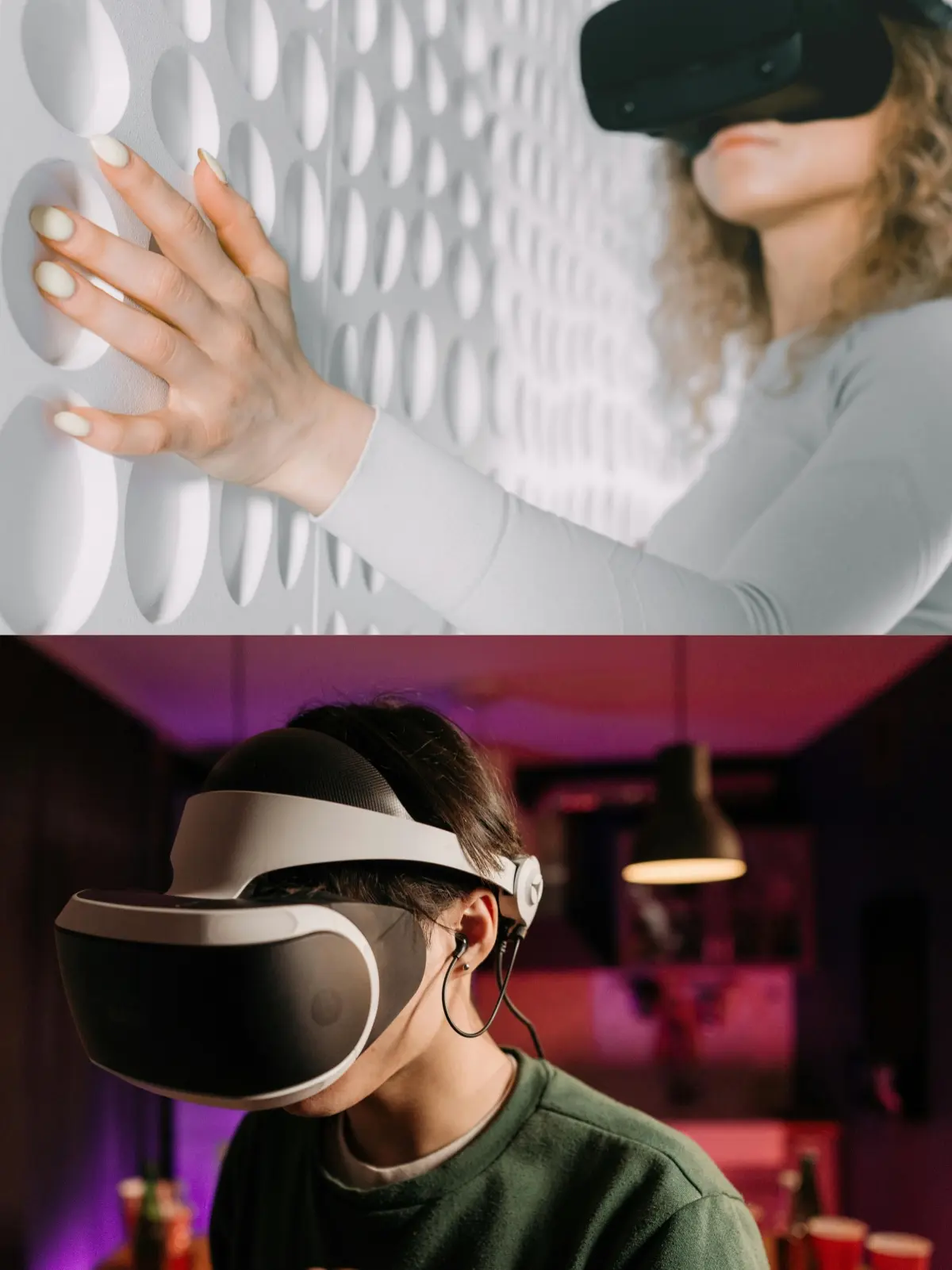
Perhaps the application of haptic feedback that is the most emotionally meaningful is social interaction. The possibility to feel a handshake, a high five or a cart holder adds emotion to a virtual communication. According to the psychological research, the use of touch is much more effective in building trust and connection than visual or verbal communication in isolation.
The Path towards Full Immersion
1. Thermal Integration
The following stage of immersion includes temperature feedback. Emerging systems are already available to create localised sensations of heating and cooling. This provides for the experience of: feeling the heat of spectroscopic fire; feeling cold water or air movement; training in a temp-critical environment. Thermal feedback brings reality and increases use value of training for safety-critical applications.
2. Integration of Neural Interfaces
The ultimate frontier is the neural integration. While fully neural haptics are the future, the hybrid systems exist today, which blend traditional haptics sensors with neural monitoring in order to adapt feedback based on stress, focus and cognitive load. This intersection of neuroscience and haptic feed back technology may eventually prove to be the end of the line between virtual and physical sensation.
Conclusion
Haptic feedback is not merely an enhancement to AR/VR, it is the key to the Sensory Internet in which digital experiences appeal to all human senses.
Vision and audio have already been made to be realistic convincingly. Touch is catching up fast with the help of advanced actuators, intelligent control algorithms and sophisticated haptic feedback sensors. Thermal integration as well as neural integration will complete the sensory loop.
This is important given that human cognition is fundamentally embodied. We understand, learn and remember through physical interaction. By stimulating the sense of touch, haptic feedback makes digital experiences more intuitive, effective and emotionally stirring.
From healthcare to manufacturing, from education to social interaction, haptic technology is already delivering a measurable return. As things become lighter, more accurate, and more integrated, the line between the physical and the virtual will be further blurred.
The haptic frontier is not only about the creation of a better game or a simulation that is more realistic. It is an essential extension of how humans interact with information, how they acquire new skills, how they collaborate across great distances and stay meaningfully connected to each other in an increasingly digital world.
As an ever-developing technological company, Bestarsensors closely pays attention to the development of haptic feedback technologies and the company successively enhances technical strength in the field of piezoelectric and sensing technologies. Ongoing breakthroughs in haptic feedback have also motivated Bestarsensors to further optimize the product performance, system stability and application depth.
Looking forward, Bestarsensors will keep its efforts in the areas of haptic interaction and piezoelectric technologies in focus, resulting in dependable and scalable offerings for a great variety of applications scenarios. For further queries about technologies for haptic feedback or with respect to piezoelectric products, we kindly invite you to get in touch with us.
 Feb,06 2026