Active Piezo Buzzer Tips for Better Sound Quality and Performance
In the world of electronic sound devices, the "Active Piezo Buzzer" stands out for its compact design and impressive sound performance. Dr. Emily Johnson, a recognized expert in acoustics, once stated, "The clarity of sound produced by an Active Piezo Buzzer can revolutionize product design." Her insights highlight the importance of optimizing buzzer performance.
Sound quality is critical in many applications, from alerts to musical instruments. An Active Piezo Buzzer offers advantages, but achieving the best sound requires understanding its characteristics. Simple adjustments can lead to significant improvements. Selecting the right frequency and ensuring proper electrical connections can enhance clarity and volume.
Yet, not everything is perfect. Some users find these buzzers susceptible to interference from other components. This can affect sound quality. Despite challenges, there are practices that can mitigate these issues. By paying attention to the environment in which the Active Piezo Buzzer operates, one can maximize its potential. It's crucial to blend knowledge with experimentation for optimal results.
Active Piezo Buzzer: Understanding Design and Construction Principles
Active piezo buzzers are fascinating components used in various electronic devices. Understanding their design and construction principles can greatly enhance sound quality and overall performance. These devices convert electrical energy into sound using mechanical vibrations. The core of their functionality lies in the piezoelectric material, which generates sound waves when an electric field is applied. Selecting the right material is crucial for achieving the desired acoustic properties.
To improve sound quality, consider adjusting the shape of the buzzer. The size and shape influence how sound travels. For instance, using a larger diaphragm can produce lower frequencies. In contrast, a smaller diaphragm will yield higher tones. Experimenting with these variables can lead to fascinating results.
Here are some tips for optimizing your active piezo buzzer. Ensure proper mounting to prevent unwanted vibrations. Use a proper power supply to avoid distortion. Also, consider the enclosure, as it significantly impacts sound distribution. Test different configurations and take notes on performance. This process requires patience and reflection, but the outcome can be rewarding. Keep exploring and refining your techniques for better results.
Active Piezo Buzzer Tips for Better Sound Quality and Performance
| Parameter |
Description |
Impact on Sound Quality |
| Resonant Frequency |
The frequency at which the piezo element vibrates most efficiently. |
Affects the loudness and tonal quality of the sound produced. |
| Drive Voltage |
Voltage applied to the piezo buzzer. |
Higher voltages can increase sound output but may affect longevity. |
| Material Type |
The material used in the piezo element. |
Different materials yield different frequencies and sound textures. |
| Size |
Physical dimensions of the piezo buzzer. |
Larger buzzers typically produce lower frequencies, while smaller ones produce higher frequencies. |
| Mounting Techniques |
Method of securing the buzzer to a surface. |
Proper mounting can enhance acoustic performance by preventing energy loss. |
Factors Influencing Sound Quality in Active Piezo Buzzers
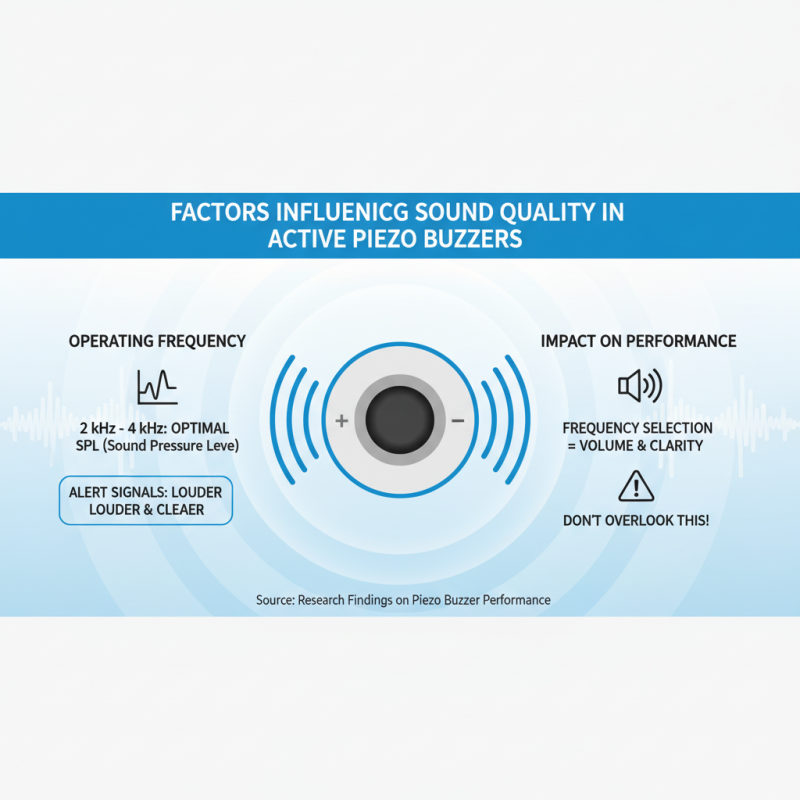
When considering the sound quality of active piezo buzzers, several factors come into play. The operating frequency significantly affects performance. Research indicates that the sound pressure level (SPL) peaks around specific frequencies, often between 2 kHz and 4 kHz. Within this range, buzzers can produce more intense sound waves, making them preferable for alert signals. Choosing the right frequency can amplify clarity and volume, yet some users might overlook this crucial aspect.
Material composition of the piezo element also contributes to sound quality. Different materials can yield distinct tonal characteristics. For example, proprietary ceramics often exhibit better resonance qualities than standard alternatives. However, not all materials are easily accessible or cost-effective, so balancing budget constraints with performance is essential. Engineers frequently report challenges when trying to find the ideal materials for specific applications, leading to potential trade-offs in sound quality.
Lastly, the circuitry and driving voltage impact buzzer performance. Higher driving voltages can enhance output but may induce distortion. Studies show that optimal voltage settings usually range from 3V to 12V. However, a mismatch can result in subpar sound fidelity or even damage to the buzzer. Achieving the right balance demands careful testing and fine-tuning, as every project presents unique challenges.
Optimal Operating Frequencies for Enhanced Performance
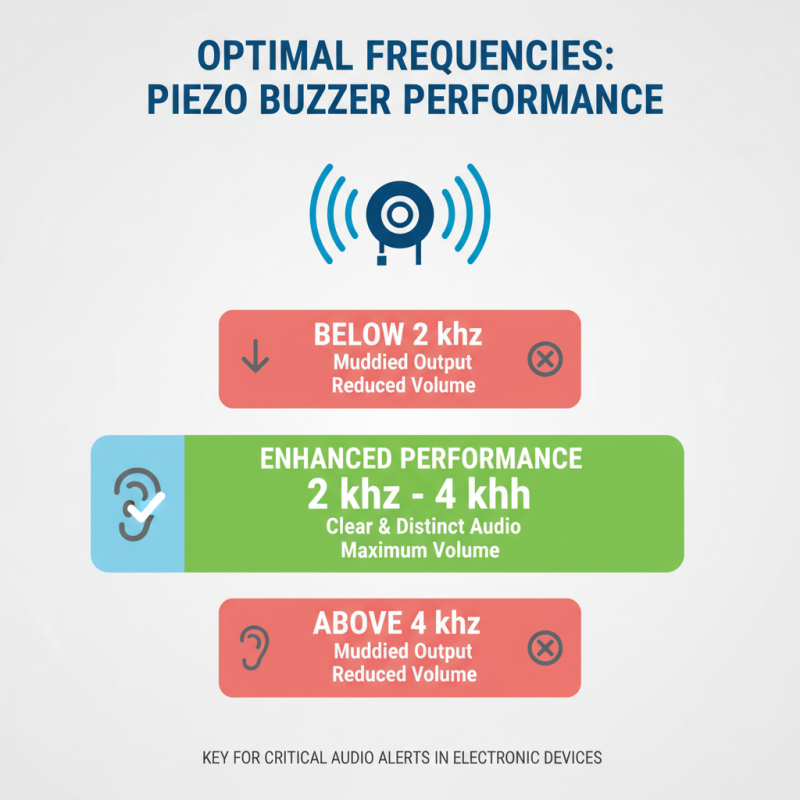
Active piezo buzzers are widely used in various electronic devices, providing critical audio alerts. To maximize their performance, understanding their optimal operating frequencies is key. Most piezo buzzers perform best between 2 kHz and 4 kHz. Within this range, the sound is clear and distinct, making alerts noticeable. Frequencies outside this range can lead to muddied output or reduced volume.
Experimenting with frequency settings can uncover surprising results. Some users find that operating at 3.5 kHz rather than 3 kHz enhances sound clarity. However, this isn’t universal. Each application can produce different outcomes, depending on the buzzer design or surrounding materials. Overdamping can lead to a soft tonal quality, while underdamping might introduce unwanted overtones.
Tuning the frequency is a process of trial and error. While many may default to manufacturer specifications, a personalized approach yields the best results. This requires patience and critical listening. If a buzzer sounds too harsh or tinny, small adjustments can be made. Finding the sweet spot for your specific application may require a few iterations and attentiveness to detail.
Comparative Analysis of Active Piezo Buzzers by Sound Pressure Levels
Active piezo buzzers are vital components in various devices, producing sound through piezoelectric materials. Understanding their performance is essential, especially when it comes to sound pressure levels (SPL). SPL indicates the loudness of the sound produced, measured in decibels (dB). According to industry data, typical active piezo buzzers have an SPL range between 70 dB and 120 dB. This variation greatly affects the perceived sound quality and application in different scenarios.
In a comparative analysis, it is crucial to examine how design factors influence SPL. For instance, the size and shape of the piezo element can significantly alter the resonance frequency and, consequently, the SPL. Research indicates that larger elements often produce louder sounds but may sacrifice tonal quality. Conversely, smaller buzzers can provide clarity but might have lower overall volume. Achieving the optimal balance between volume and clarity remains a challenge for many engineers.
Noise pollution is another consideration. High SPL levels can contribute to adverse acoustic environments. It is important to reflect on how increased decibel levels affect both user comfort and device functionality. An effective approach involves selecting buzzers based on their specific application requirements while minimizing potential downsides. Ultimately, testing different combinations in real-world settings often yields the best results for sound quality and performance.