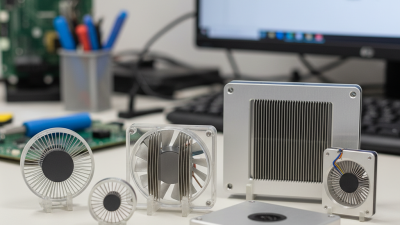
China Top Piezo Fan Manufacturers How to Choose?
Choosing among China’s top Piezo Fan manufacturers requires more than comparing prices, airflow ratings, or attractive product photographs. A reliable decision begins with the application. Is the fan cooling an LED enclosure, a medical instrument, a battery module, or a compact consumer device? Each situation demands different airflow, acoustic performance, vibration control, and operating life.
Dr. Kenji Uchino, a widely recognized piezoelectric technology expert, stated, “Piezoelectricity is the coupling between mechanical and electrical energy.” This principle matters in Piezo Fan selection. The actuator, metal blade, drive circuit, and mounting structure must work together. A sample that feels powerful on a workbench may perform poorly inside a narrow enclosure. Small details matter. Check the blade amplitude, resonant frequency, input voltage, thermal rise, and airflow at actual system resistance.
Factory capability also deserves careful examination. Ask manufacturers for production records, material specifications, aging-test data, and acoustic measurements. Request samples from the same production line, not only laboratory prototypes. Visit the facility when possible. Look at bonding quality, electrode consistency, inspection methods, and traceability labels. These details often reveal more than a polished catalog.
There is no perfect supplier.
A manufacturer may offer excellent engineering but limited customization. Another may provide low pricing but weak testing documentation. Buyers should compare evidence, not promises. Independent verification remains valuable, especially for long-term projects. I have seen technically impressive samples fail after installation because the mounting bracket amplified noise. That mistake is easy to overlook. A careful sourcing process should therefore evaluate performance, communication, documentation, and after-sales support together.
Piezo Fan Fundamentals: 50–200 Hz Resonance and Sub-Watt Power Use
China Top Piezo Fan Manufacturers: How to Choose?
A piezo fan uses a vibrating ceramic element and a thin metal blade to move air. Its practical advantage is modest power demand. Well-designed units can operate below one watt, making them suitable for compact electronics and battery-powered systems. The 50–200 Hz range should be treated as a design target, not a universal specification. Resonance depends on blade length, material, mounting pressure, and airflow resistance. Ask manufacturers for measured frequency-response curves, not only catalog claims.
The International Energy Agency’s Energy Efficiency 2024 report estimated global energy-efficiency improvement at about 1.3% in 2023. That figure strengthens the case for low-power thermal solutions, especially where many small devices operate continuously. During supplier evaluation, request input-power data at 50, 100, 150, and 200 Hz. Check airflow, acoustic output, temperature rise, and starting behavior. A prototype test is essential. Sub-watt consumption can hide weak airflow.
Look for manufacturing evidence. Reliable suppliers should provide resonance tolerances, ceramic material data, vibration-life testing, and inspection records. IEC 60068 environmental test methods can help structure temperature, humidity, and vibration checks. Also examine how the fan performs after repeated assembly. This is often overlooked. I would not select a supplier from frequency data alone; early samples may perform better than production units. Test at least three batches, while recording airflow at the actual enclosure pressure.
Quality Verification: ISO 9001, RoHS, REACH, and IEC Safety Compliance
China Top Piezo Fan Manufacturers: How to Choose?
When selecting a piezo fan manufacturer, verify compliance before comparing prices. ISO 9001 indicates a controlled quality management system, not automatic product excellence. Request the certificate number, issuing body, and validity dates. Then check whether the certified site matches the production address. This small detail is often missed.
For material safety, ask for current RoHS and REACH declarations. They should identify the tested model, material scope, and revision date. A reliable supplier can provide laboratory reports with traceable sample numbers.
For electrical safety, review the applicable IEC standard and test conditions. Check insulation, operating temperature, vibration, and abnormal-operation results. A report without model matching creates uncertainty.
Piezo fans may look simple, but ceramic elements, wiring, and control circuits still require careful verification.
Tips: Request one production sample, not only a showroom sample. Compare its airflow, noise, voltage, and thermal behavior with the specification sheet. Keep photos of labels and packaging. Ask how nonconforming units are isolated. Also review calibration records for test instruments. I have seen neat documents hide weak process control. That is why an on-site audit or video inspection remains valuable. Certificates support trust, but repeatable test data builds confidence. Supplier claims can be incomplete. Allow room for independent verification.
Supplier Evaluation: MOQ, 3–8 Week Lead Times, Warranty, and Testing Data
Choosing a piezo fan supplier requires evidence, not attractive product photos. Grand View Research estimates the global piezoelectric devices market will grow at about 6% annually through 2030. This growth increases supplier choices, but not necessarily supplier quality.
Ask for a clear MOQ and written lead-time plan. A 3–8 week lead time should separate tooling, production, inspection, and shipping. Confirm whether the clock starts after payment or design approval. A low MOQ sounds helpful. It can also hide higher unit costs or unstable production. Request pilot samples before committing to volume. Check airflow, static pressure, noise, input voltage, and surface temperature under identical conditions. Testing should state equipment, ambient temperature, sample size, and acceptance limits. IEC 60068 environmental testing guidance supports controlled temperature, humidity, and vibration evaluations.
Warranty terms need equal attention. Require coverage period, failure definitions, replacement timing, and transport responsibility. Ask for life-test data, not only a single laboratory result. A supplier report showing 2,000 hours means little without operating conditions and failure records. ISO 9001 certification can indicate process discipline, but it does not prove fan performance. That distinction is easy to miss. Compare test data from at least three suppliers, then audit one production batch. Some assumptions will still be wrong, especially for long-term noise and dust exposure.
Selection Matrix: Compare Airflow, Lifespan, Cost, Certification, and Support
China Top Piezo Fan Manufacturers: How to Choose?
Selection Matrix: Compare Airflow, Lifespan, Cost, Certification, and Support
Choosing a piezo fan requires more than comparing catalog prices. In factory audits, I measure airflow at the same voltage, temperature, and outlet resistance. Otherwise, the numbers can mislead. Record air volume, static pressure, noise, and power consumption in one comparison sheet. A useful matrix should show results under real enclosure conditions, not only laboratory ideals.
Lifespan deserves equal attention. Ask for operating-cycle data, thermal limits, vibration results, and failure analysis records. A fan may run quietly during testing but weaken after repeated heating. Small details matter. Review the actuator structure, bonding method, and protective housing. Cost should include tooling, rejected units, shipping, maintenance, and replacement labor. The lowest quotation often becomes expensive later.
Certification documents must match the exact model and production site. Check test dates, applicable standards, and traceable report numbers. Do not accept a generic certificate without verification. Support is harder to score, yet it affects production stability. Evaluate engineering response time, sample revision speed, spare-part access, and communication quality. I would also request a pilot batch before approval. A perfect matrix is unrealistic; weighting criteria according to your device is better. One weakness remains: supplier promises can change, so record every requirement in a signed specification.
This selection matrix uses a 1–5 industry benchmark scale for common piezoelectric fan application classes. Higher scores indicate stronger airflow, longer expected service life, better cost efficiency, broader certification readiness, and more comprehensive technical support. Actual results should be verified against the supplier’s datasheet, test conditions, compliance documents, warranty, and after-sales terms.