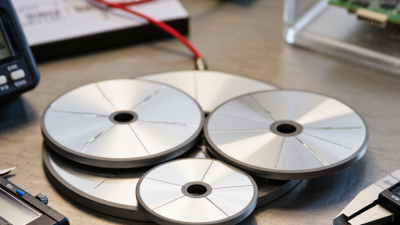
Top PZT Material Suppliers for Global Buyers
Global demand for Pzt Material is expanding with sensors, medical ultrasound, precision actuators, and industrial monitoring. Grand View Research estimated the global piezoelectric devices market at approximately USD 30 billion in 2023. Its analysis also forecasts continued growth through 2030. Fortune Business Insights reports similar momentum, although market boundaries differ between studies. These figures cover broader piezoelectric technologies, not PZT alone. That distinction matters.
For global buyers, supplier selection should go beyond a polished catalog. A reliable manufacturer should provide d33 values, dielectric loss data, Curie temperature records, aging results, and batch traceability. These details reveal whether a Pzt Material grade can survive repeated vibration, thermal cycling, or high-voltage operation. ISO 9001 certification supports process consistency, but certification alone is not proof of stable performance. Ask for recent test reports.
Application experience is equally important. A supplier serving automotive ultrasonic systems may not excel in medical transducer ceramics. Packaging also deserves attention. Moisture barriers, shock protection, and clearly labeled batches can prevent damage before production begins. Regional compliance documents, including RoHS and REACH declarations, may simplify international procurement. However, requirements vary by destination and product use.
No supplier is perfect. Some published specifications may represent laboratory results rather than continuous production averages. Buyers should compare samples, tolerances, lead times, and technical responses before signing long-term agreements. The strongest suppliers explain limitations clearly. That honesty is useful. This guide examines leading PZT Material suppliers through performance, manufacturing capability, documentation, customization, and supply reliability.
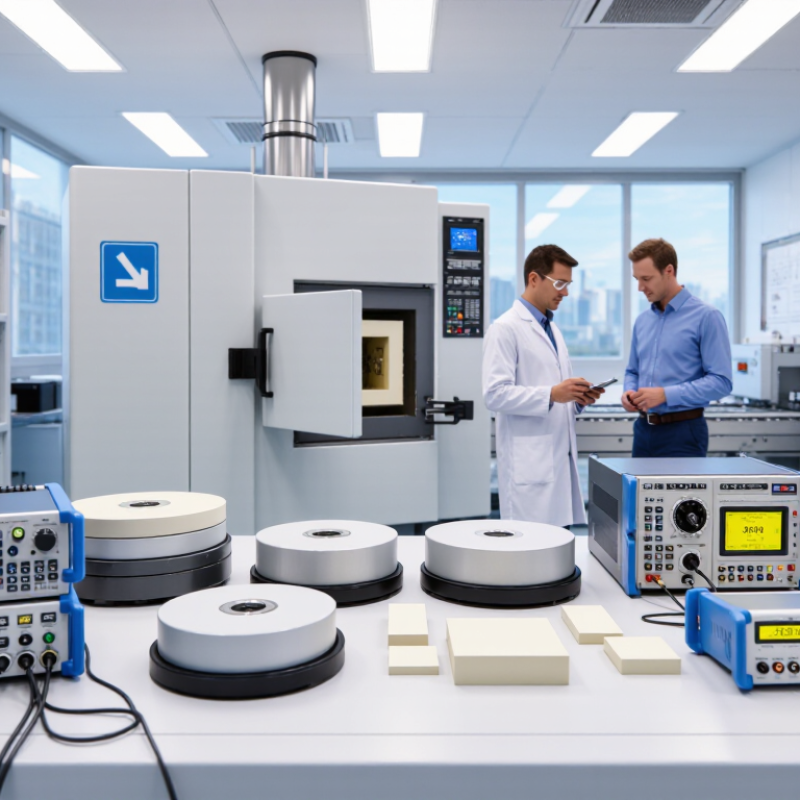
PZT Fundamentals: d33 200–700 pC/N and Curie Temperatures of 200–350°C
Top PZT Material Suppliers for Global Buyers
PZT Fundamentals: d33 200–700 pC/N and Curie Temperatures of 200–350°C
Lead zirconate titanate, or PZT, converts mechanical stress into electrical charge. Its d33 value commonly ranges from 200 to 700 pC/N. Higher d33 can improve sensor output, but it does not guarantee better performance. Mechanical strength, dielectric loss, electrode design, and aging also matter.
Curie temperature usually falls between 200°C and 350°C. Above this point, the material loses stable ferroelectric behavior and piezoelectric performance declines sharply. Buyers should compare the stated Curie temperature with the actual operating temperature. A design exposed to vibration, heat, and repeated cycling needs a practical safety margin.
Supplier evaluation requires more than reading a catalog. Ask for d33 test conditions, frequency, polarization details, density, tolerance data, and batch records. Testing methods can vary, so identical numbers may not be directly comparable. Small ceramic samples may perform differently after machining or bonding. This is easy to overlook.
Reliable suppliers should explain aging behavior and provide traceable inspection reports. Sample testing remains valuable. It can reveal uneven polarization, brittle edges, or unexpected resonance shifts. The quoted specification is only a starting point. Real assemblies sometimes behave differently, and that gap deserves careful investigation.
PZT Grade Selection: Evaluate kp, Qm, d31, Density, and Dielectric Constant
Top PZT Material Suppliers for Global Buyers
PZT Grade Selection: Evaluate kp, Qm, d31, Density, and Dielectric Constant
Selecting a PZT grade requires more than comparing one impressive number. In actuator testing, I examine kp, the electromechanical coupling factor, alongside operating frequency and temperature. A higher kp can improve energy conversion, but it may reduce mechanical stability in demanding resonant systems. Qm matters when losses must remain low during continuous vibration. High-Qm materials often suit ultrasonic transducers, transformers, and narrow-band devices. However, they may respond less flexibly across wider frequency ranges.
The d31 coefficient describes transverse strain under an electric field. It is critical for bending actuators and multilayer structures. Check its sign, test direction, and measurement conditions carefully. Density affects counterweight design, acoustic impedance, and shipping calculations. Small density differences can change a transducer’s matching layer performance. Do not overlook dielectric constant. It influences capacitance, drive current, insulation design, and amplifier loading. High values are not automatically better.
Request test data at defined temperature, frequency, and field strength. Compare batch variation, not only nominal values. Ask for dimensional tolerances and aging information. I prefer evaluating sample parts before approving volume supply. One spreadsheet can hide real production variation. That mistake is easy to make. A reliable supplier should provide traceable measurements, clear datasheets, and practical engineering feedback. Still, supplier data needs independent verification. PZT selection becomes more dependable when kp, Qm, d31, density, and dielectric constant are judged together.
Top PZT Material Suppliers for Global Buyers - PZT Grade Selection: Evaluate kp, Qm, d31, Density, and Dielectric Constant
| Generic PZT Grade |
Material Type |
Electromechanical Coupling, kp |
Mechanical Quality Factor, Qm |
Piezoelectric Coefficient, d31 |
Density |
Relative Dielectric Constant, εr |
Typical Selection Use |
| PZT-4 |
Hard PZT ceramic |
0.48–0.52 |
500–1,200 |
−90 to −110 pC/N |
7.5–7.7 g/cm³ |
1,100–1,400 |
High-power transmitters, sonar, ultrasonic cleaning, and applications requiring low dielectric and mechanical loss. |
| PZT-5A |
Moderately soft PZT ceramic |
0.60–0.66 |
60–100 |
−170 to −190 pC/N |
7.5–7.7 g/cm³ |
1,500–1,800 |
General-purpose sensors, actuators, hydrophones, medical transducers, and balanced drive-sensing designs. |
| PZT-5H |
Very soft, high-sensitivity PZT ceramic |
0.68–0.72 |
50–75 |
−270 to −300 pC/N |
7.4–7.6 g/cm³ |
3,000–3,500 |
High-displacement actuators, precision motion, low-frequency sensors, and high-sensitivity ultrasound devices. |
| PZT-8 |
Very hard, high-power PZT ceramic |
0.48–0.52 |
800–1,500 |
−80 to −100 pC/N |
7.5–7.7 g/cm³ |
900–1,200 |
High-drive sonar, power ultrasonics, resonant transformers, and continuous-duty applications with strong thermal loading. |
| PZT-5 |
Soft PZT ceramic |
0.62–0.68 |
60–100 |
−180 to −220 pC/N |
7.4–7.6 g/cm³ |
1,700–2,200 |
Cost-sensitive sensors, buzzers, vibration pickups, and general electromechanical conversion. |
| High-Temperature Hard PZT |
Hard PZT ceramic for elevated-temperature service |
0.45–0.53 |
300–900 |
−70 to −105 pC/N |
7.5–7.8 g/cm³ |
900–1,500 |
Industrial monitoring, engine sensors, downhole instrumentation, and designs requiring improved temperature stability. |
Property guide: Higher kp generally indicates stronger electromechanical conversion; higher Qm is preferred for high-power resonant operation; a larger absolute d31 supports greater transverse strain or sensing output; density affects mass loading and acoustic impedance; dielectric constant influences capacitance, drive current, and electrical matching.
Buyer Qualification Checklist: MOQ, Tolerance, Traceability, and Lead Time
Qualifying a PZT supplier starts with measurable evidence, not attractive sample photos.
MarketsandMarkets’ 2024 piezoelectric devices report forecasts roughly 6% annual market growth through 2029. That growth increases pressure on capacity and delivery promises. Ask for MOQ by grade, geometry, and electrode finish. A practical trial order may require 10–100 pieces, while production lots can require several thousand. Confirm whether tooling charges are separate. Small buyers often miss this detail.
Define tolerance before requesting quotations.
Record dimensions, capacitance, dielectric constant, d33, coupling coefficient, resonance frequency, and flatness. Require test conditions and measurement uncertainty. A stated ±5% value means little without temperature and frequency settings. Request three consecutive lot reports, not one perfect report. Supplier experience matters here. PZT performance can shift after firing. I would also question unusually tight tolerances that lack process capability data.
Traceability should connect each part to powder batch, pressing date, firing cycle, electrode batch, and final inspection record.
The 2024 USGS Mineral Commodity Summaries reported about 4.5 million metric tons of mined lead production worldwide in 2023, but raw-material volume does not prove ceramic consistency. Request lot codes, retention samples, conformity declarations, and change-notification procedures. For lead times, obtain separate schedules for samples, tooling, pilot lots, and repeat production. Two to four weeks for samples and six to twelve weeks for production are useful planning benchmarks, not guarantees. My own checklist would include a contingency buffer; suppliers sometimes quote the ideal route, and buyers often plan around it.